Ingredients
For the cake:
4 large eggs, separated into yolks and whites
250 g cream cheese, softened
½ cup (120 ml) milk
¼ cup (60 g) unsalted butter
½ cup (100 g) granulated sugar, divided
½ cup (60 g) all-purpose flour
2 tablespoons cornstarch
1 teaspoon vanilla extract
1 teaspoon lemon juice
A pinch of salt
For the baking dish:
A little butter for greasing
Parchment paper
Hot water for the water bath
Step-by-Step Instructions
Step 1: Prepare the oven and baking dish
Preheat your oven to 160°C (320°F). Select an oven-safe glass baking dish that is deep and rectangular in shape. If appropriate for your dish, line the sides and bottom with parchment paper after lightly greasing the interior with butter.
Prepare a larger roasting tray that can hold the baking dish. You will use this tray for a water bath, which helps the cake bake gently and keeps its texture moist
If using a glass dish, make sure it is oven-safe and suitable for the temperature changes involved. Avoid pouring boiling water around cold glass, as sudden temperature changes can cause it to crack.
Step 2: Melt the cream cheese mixture
Put the milk, butter, and softened cream cheese in a heatproof bowl. Set the bowl over a saucepan of gently simmering water, ensuring the bottom of the bowl does not touch the water.
Stir slowly until the butter melts and the cream cheese becomes smooth. You can also warm the ingredients gently in a microwave in short intervals, stirring between each interval.
Remove the bowl from the heat and let the mixture cool for several minutes. It should be warm rather than hot before you add the egg yolks.
Step 3: Add the egg yolks
Separate the four eggs carefully, placing the yolks in one bowl and the whites in a completely clean, dry mixing bowl.
Add the egg yolks to the cooled cream cheese mixture one at a time, whisking after each addition. Stir in the vanilla extract and a pinch of salt.
Continue whisking until the mixture looks smooth, creamy, and evenly combined. Avoid adding the yolks while the mixture is too hot, as this could partially cook them.
Step 4: Add the dry ingredients
Sift the all-purpose flour and cornstarch together to remove lumps. Add them gradually to the cream cheese mixture.
Whisk gently until the flour disappears and the batter becomes smooth. Do not overmix, as excessive mixing can make the texture heavier.
For an especially smooth cake, pass the batter through a fine-mesh sieve into another bowl. This removes any small lumps of cream cheese or flour.
Step 5: Whip the egg whites
Add the lemon juice to the egg whites. Using a clean electric mixer, beat the whites at medium speed until they become foamy.
Gradually add half of the sugar, continuing to beat until the mixture forms glossy, medium-stiff peaks. When you lift the beaters, the peaks should hold their shape but still have a slight bend at the tips.
Avoid beating the egg whites until they become dry or grainy. Properly whipped whites are essential for creating the cake’s tall, fluffy texture.
Step 6: Fold the egg whites into the batter
Add about one-third of the whipped egg whites to the cream cheese batter. Stir gently to loosen the mixture.
Add the remaining egg whites in two portions. Use a spatula to fold from the bottom of the bowl upward, turning the bowl as you work.
Continue until no large white streaks remain. Be gentle and avoid vigorous stirring because the trapped air helps the cake rise during baking.
Step 7: Pour the batter into the dish
Pour the finished batter into your prepared baking dish. Fill it to approximately two-thirds or three-quarters of its depth, leaving room for the cake to rise.
Gently tap the dish once or twice against a folded kitchen towel to release any large air bubbles. Smooth the surface with a spatula.
Place the baking dish inside the larger roasting tray. Carefully pour hot water into the outer tray until it reaches about halfway up the sides of the baking dish.
Step 8: Bake until golden
Carefully transfer the water bath to the preheated oven. Bake at 160°C (320°F) for approximately 15 minutes, then reduce the temperature to 140°C (285°F) and continue baking for another 30–45 minutes.
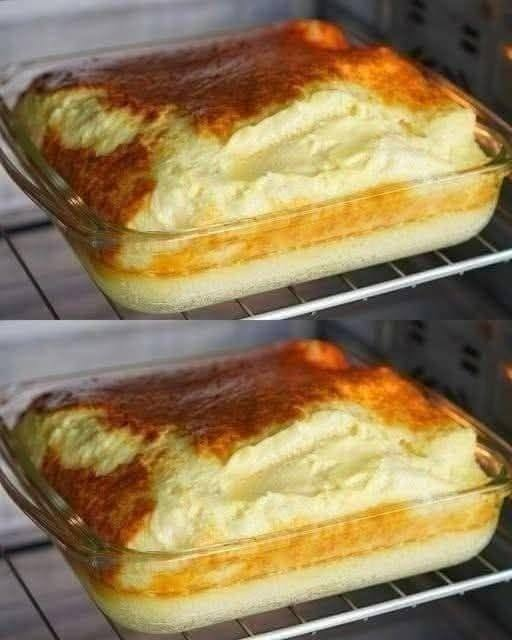
The cake should rise and develop a golden-brown top, similar to the dessert in your photograph. Baking times vary according to the depth of the dish and the accuracy of your oven.
Avoid opening the oven door frequently, especially during the first 35–40 minutes. Sudden temperature changes can cause the cake to collapse.
The cake is ready when the top is golden and the center is set but retains a slight, gentle wobble. If the top browns too quickly, loosely cover it with foil.
Step 9: Cool the cake gradually
Turn off the oven when the cake is baked. Leave the door slightly open and allow the cake to rest inside for about 10–15 minutes.
Remove the water bath carefully, then take the baking dish out of the roasting tray. Allow the cake to cool gradually at room temperature.
A small amount of shrinking is normal. Gradual cooling helps reduce sudden collapse and keeps the cake’s interior tender.
Step 10: Serve and enjoy
Serve the cake slightly warm for a soft, delicate texture, or refrigerate it for 2–3 hours if you prefer a firmer, cheesecake-like consistency.
Cut into squares using a sharp knife, wiping the blade between cuts. You can serve it plain or dust the top lightly with icing sugar.
For the best flavor, refrigerate leftovers in an airtight container and consume within 3–4 days. Keep the cake refrigerated because it contains eggs and cream cheese.
Tips for the best results
Use room-temperature ingredients: Cream cheese and eggs combine more smoothly when they are not cold.
Keep the egg whites clean: Even a small amount of egg yolk or grease can prevent the whites from whipping properly.
Fold, don’t beat: Gentle folding preserves the air needed for a fluffy cake.
Use a water bath: It provides gentle, even heat and helps prevent the edges from drying out.
Do not rush cooling: Gradual cooling helps minimize shrinking and cracking.