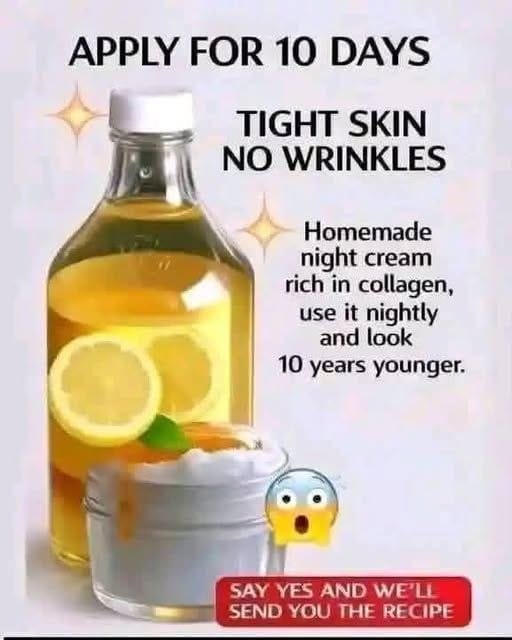
After a long day, taking a little time for yourself can be reassuring. Just a few basic materials, a peaceful evening, and a little self-care—no elaborate regimen, no pricey spa treatment.
My friend, who was constantly sharing her best natural skincare tips with me, told me about this homemade collagen nite cream. She informed me that she had been using a basic homemade moisturiser at nite and was pleased with how moisturised and smooth her skin felt the following morning..
Homemade Collagen Night Cream — Anti-Inflammatory DIY Skincare
The image describes a homemade “collagen night cream,” but there is an important distinction: a homemade oil-and-lemon mixture is not clinically proven to increase collagen or make skin look 10 years younger. Lemon/citrus juice can also irritate skin and, with sunlight exposure, can cause phytophotodermatitis, including redness, blistering, and prolonged hyperpigmentation.
For a safer DIY anti-inflammatory skincare approach, I would leave fresh lemon juice out and make a simple, fragrance-free moisturizing balm instead.
🌿 Gentle Anti-Inflammatory Night Cream
Description
This homemade-style skin barrier moisturizer is designed to help soften dry skin and reduce moisture loss overnight. It uses soothing, emollient ingredients rather than citrus or fragrance.
Ingredients
- 2 tablespoons pure aloe vera gel — preferably a commercially preserved, fragrance-free product
- 1 tablespoon jojoba oil
- 1 tablespoon shea butter
- 1 teaspoon colloidal oatmeal
- 2–3 drops vitamin E oil — optional
Important: Because aloe vera contains water, this mixture is not shelf-stable without an appropriate cosmetic preservative. For a homemade product, make a very small batch, keep it refrigerated, use clean utensils, and discard it promptly if its appearance, smell, or texture changes. A professionally formulated, preservative-containing fragrance-free moisturizer is the safer option for regular use.
How to Make It
- Gently melt the shea butter using a double boiler.
- Remove it from heat and allow it to cool slightly.
- Stir in the jojoba oil and colloidal oatmeal.
- Once cool, mix in the aloe vera gel and optional vitamin E.
- Transfer to a clean container.
- Refrigerate and use a clean spatula or spoon rather than dipping fingers into the container.
How to Use
At night:
- Wash your face with a gentle, fragrance-free cleanser.
- Pat the skin dry, leaving it slightly damp.
- Apply a small amount of the moisturizer.
- Gently massage it into the skin.
- Leave it on overnight.
Dermatologists generally recommend fragrance-free moisturizers for dry or sensitive skin and applying moisturizer while skin is still damp.
Patch Test First
Before applying a new DIY skincare product to your face, test it on a small area. The American Academy of Dermatology recommends testing new skincare products on a small area for 7–10 days and stopping if redness, itching, swelling, or another reaction develops.
🍋 What About the Lemon in the Picture?
I wouldn’t recommend putting fresh lemon juice on your face.
Although lemon is often promoted online for “brightening skin,” citrus exposure can cause phototoxic reactions when followed by UV exposure. The resulting inflammation can sometimes leave dark pigmentation behind.
For brightening skin, reducing the appearance of dark spots, anti-aging skincare, and collagen-supporting skincare, a properly formulated commercial product is generally a better choice than applying kitchen ingredients directly to your face.
Serving Suggestions
Since this is skincare rather than food, “serving” means application:
- Face: Use a pea-sized amount.
- Neck: Use another small amount if needed.
- Hands: Apply a slightly thicker layer to dry areas.
- Night routine: Cleanser → treatment/serum if appropriate → moisturizer.
- Morning: Moisturizer → broad-spectrum SPF 30+ sunscreen.
Sun protection is particularly important for preventing premature skin aging and protecting skin from UV-related damage.
Variations
1. Ultra-Simple Sensitive-Skin Version
Use only:
- Shea butter
- Jojoba oil
- Colloidal oatmeal
This removes aloe and reduces the number of ingredients.
2. Dry-Skin Version
Increase the shea butter slightly for a richer skin barrier repair balm.
3. Oily-Skin Version
Use less shea butter and more lightweight jojoba oil. Apply a very thin layer.
4. Fragrance-Free Anti-Aging Version
Skip essential oils, perfumes, lemon, and other potentially irritating additions. Fragrance-free skincare is generally preferable for sensitive or eczema-prone skin.
Nutrition Information
Not applicable. This is a topical skincare preparation and is not intended for consumption. Nutrition facts such as calories, protein, carbohydrates, fat, vitamins, and minerals therefore aren’t meaningful for this recipe.
Also, don’t assume that because an ingredient is nutritious when eaten, it is automatically beneficial or safe when applied directly to the skin.
Possible Benefits
A simple moisturizer may help:
- Improve skin hydration
- Reduce dryness and roughness
- Support the skin barrier
- Make fine lines caused by dehydration appear less noticeable
- Leave skin feeling softer and smoother
- Reduce irritation caused by excessive dryness
These effects are different from actually eliminating wrinkles or increasing collagen production.
Related Questions
Does homemade collagen cream actually contain collagen?
Not necessarily. The recipe in the image doesn’t establish that it contains collagen, and applying a kitchen-made mixture doesn’t mean your skin will produce more collagen.
Can this remove wrinkles in 10 days?
There is no good basis for the image’s promise of “no wrinkles” or looking “10 years younger.” Hydration can temporarily make skin appear smoother, but that’s not the same as reversing structural aging.
Is lemon good for facial skin?
Fresh lemon juice is not my recommendation for facial skincare, particularly because of irritation and photosensitivity concerns.
Can I use this every night?
If your skin tolerates the ingredients, a bland moisturizer can generally be part of a nightly skincare routine. However, homemade water-containing cosmetics are difficult to preserve safely.
What is better for anti-aging skincare?
A simple routine built around gentle cleansing, moisturizer, and daily broad-spectrum SPF 30+ sunscreen is a much more reliable foundation.
Can I add essential oils?
I wouldn’t. Essential oils and fragrance can irritate sensitive skin, so a fragrance-free skincare routine is the safer choice.
⚠️ Safety Notes
Don’t apply this or other DIY products to broken, infected, severely irritated, or sunburned skin. Stop immediately if you experience burning, swelling, itching, rash, or blistering.
If you have persistent inflammation, eczema, rosacea, significant acne, or unexplained pigmentation, it’s better to get advice from a dermatologist rather than experimenting with increasingly concentrated homemade ingredients.
Final Thoughts
The viral “Homemade Collagen Night Cream” image makes attractive anti-aging claims, but those claims shouldn’t be taken literally. A better natural skincare / DIY skincare philosophy is to keep the formula simple, avoid fresh citrus and fragrance, prioritize skin hydration and barrier repair, and use sunscreen consistently.